Migration and Modernisation Are Becoming the Foundation for AI Transformation
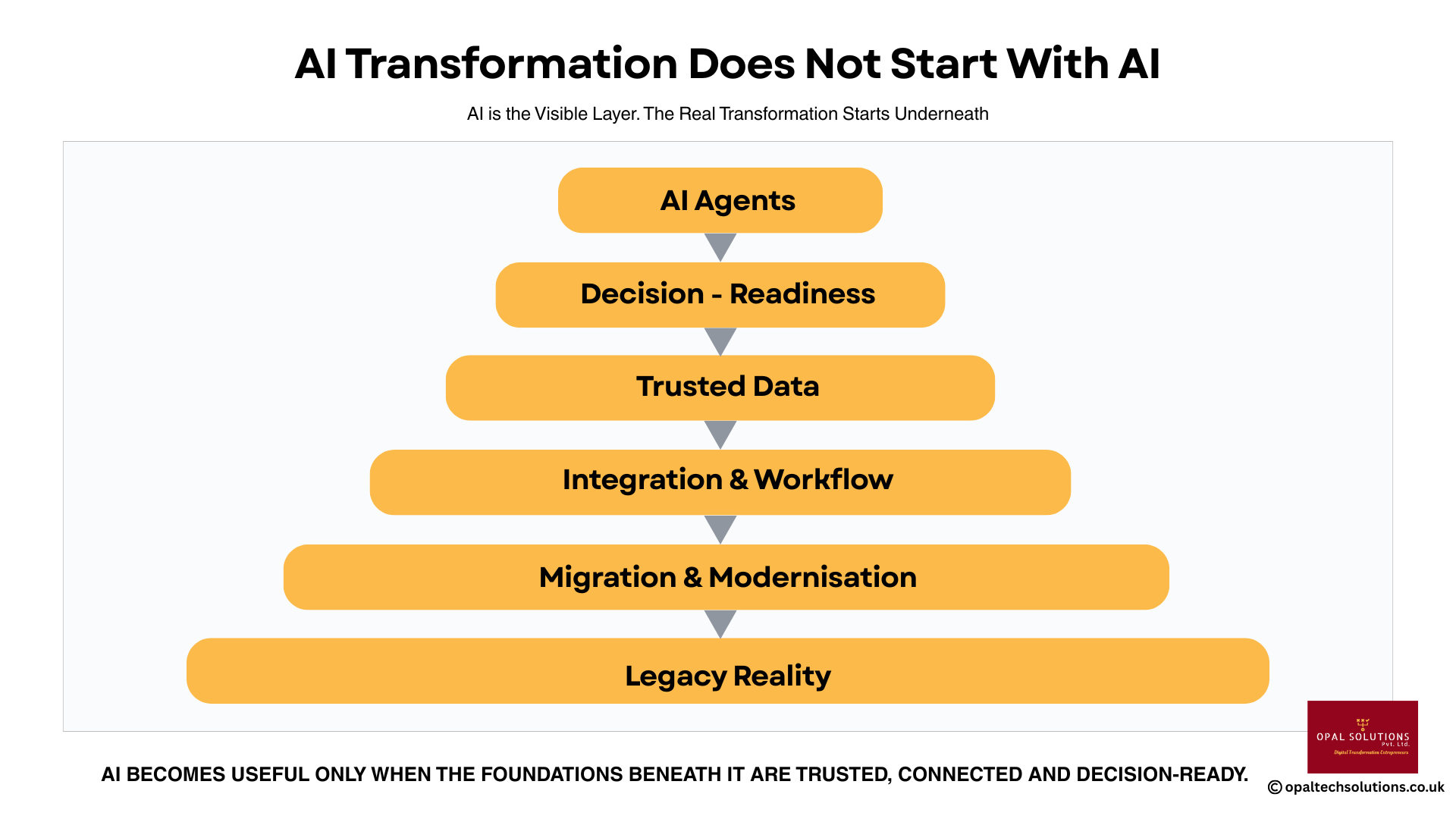
Most organisations are talking about AI transformation as if it starts with AI.
It does not.
AI transformation starts much earlier.
It starts with the systems AI is expected to read, the data it is expected to trust, the processes it is expected to support, the integrations it is expected to use, and the governance model that decides what AI is allowed to do.
This is why migration and modernisation are becoming far more than technical programmes.
They are becoming the foundation on which credible AI transformation will either succeed or fail.
The organisations that understand this early will not simply move faster with AI. They will make better decisions about what AI should and should not be allowed to influence.
That distinction matters.
Because AI does not fix organisational complexity. It accelerates whatever condition the organisation is already in.
If the data is trusted, the workflows are clear, and the systems are connected, AI can help create speed, insight and consistency.
If the data is fragmented, the workflows are unclear, and the systems are poorly understood, AI can amplify confusion, automate weak assumptions and make poor decisions look more authoritative than they really are.
That is the uncomfortable truth.
The future of AI transformation will not be decided only by who chooses the best model. It will be decided by who has done the hard modernisation work underneath.
Migration is Where AI Inherits its Version of Reality
For years, migration has often been treated as a technical transition.
Move the data from the old system to the new one. Map the fields. Cleanse what is necessary. Reconcile the totals. Test the outputs. Go live.
That work is still essential. But AI changes its significance.
In an AI-enabled organisation, migration is not just about moving records. It is about deciding what the next generation of digital systems will believe to be true.
Which property record is the master? Which resident status is current? Which asset belongs to which block? Which compliance evidence is valid? Which repair is genuinely complete? Which exception is operationally serious? Which note is historical noise and which one represents live risk?
These are not small technical decisions.
They are future AI decisions.
If those relationships are wrong, incomplete or poorly governed, an AI agent may not simply report bad data. It may use that data to recommend action, prioritise work, summarise risk or influence service decisions.
That is why migration is becoming strategic.
It is the point at which an organisation either preserves old confusion or creates a cleaner foundation for future intelligence.
The UK Government’s guidance on making government datasets ready for AI reinforces this direction. It describes AI-ready data as accurate, complete, consistent, secure, enriched with metadata, and supported by standards for quality, governance, metadata, APIs and human oversight.
That should change how leaders think about migration.
Migration is no longer just a data movement exercise. It is the moment an organisation decides what future AI systems will inherit as truth.
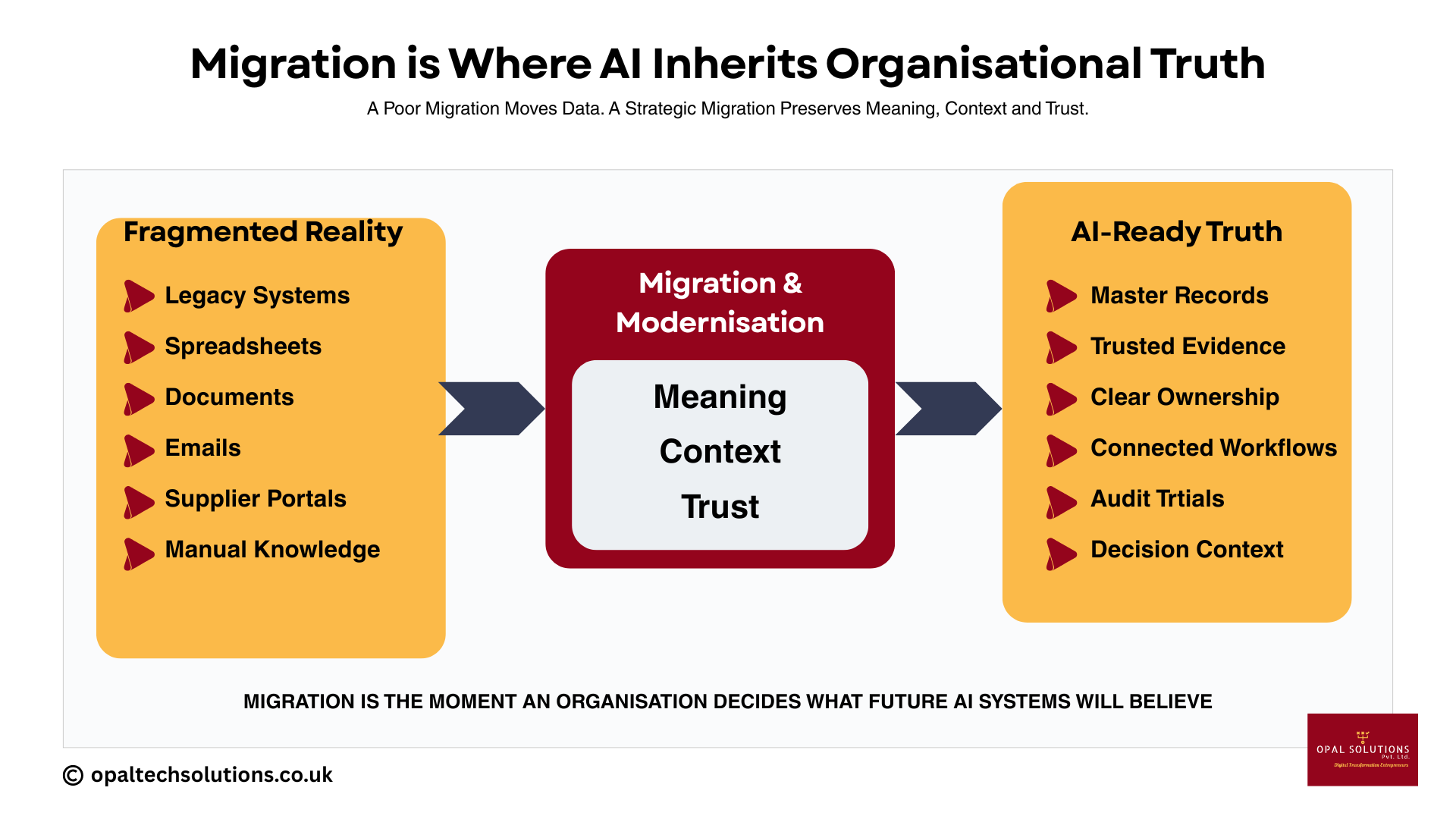
A poor migration moves data. A strategic migration preserves meaning, context and trust.
The Air Canada Lesson: AI without a governed source of truth creates liability
One of the most useful real-world lessons comes from outside the public sector.
In the widely discussed Moffatt v Air Canada chatbot case, Air Canada was held liable after its chatbot gave a customer misleading information about bereavement fare rules.
The important point is not simply that a chatbot made a mistake. Mistakes will happen.
The important point is that the organisation could not distance itself from the answer given by its own digital channel.
For public-sector organisations, this lesson is profound.
Imagine a council AI assistant giving a resident incorrect information about housing eligibility, repair responsibilities, homelessness duties, council tax support, complaints, safeguarding routes or compliance action.
The question would not be: “Did the AI intend to mislead?”
The question would be: “Why did the organisation allow an automated channel to provide guidance that was not properly governed, sourced, checked or bounded?”
This is where modernisation becomes essential.
AI systems need governed sources of truth. They need clear boundaries. They need access to the right information, not every piece of information. They need audit trails. They need human escalation. They need confidence that policy, system data and operational reality do not contradict each other.
That is not only an AI problem.
It is a data, integration, process and governance problem. In other words, it is a modernisation problem.
The Birmingham Lesson: System modernisation can become organisational risk
Another important lesson comes from local government itself.
Birmingham City Council’s ERP implementation became a major public-sector example of how a core system change can create operational, financial and governance problems when implementation, controls and reliable information are not sufficiently managed. The council published a notice of public interest report relating to the ERP implementation, alongside the public interest report on the ERP implementation.
The relevance to AI is not that AI caused the problem. It did not.
The relevance is more important than that.
If a core system implementation can leave an organisation struggling with reliable operational and management information, then layering AI on top of that environment would not solve the issue. It could make the problem harder to detect.
AI can make weak information look fluent.
That is the danger.
A poorly modernised organisation may still produce reports, dashboards and automated summaries. But if the underlying data model, controls, reconciliations and processes are not trusted, the outputs become dangerous precisely because they appear confident.
This is one of the least discussed risks in AI transformation.
The risk is not only that AI hallucinates. The risk is that AI accurately summarises an organisation’s existing disorder.
For public-sector leaders, this should change the way modernisation is viewed. A system migration is not just an IT project. It is an organisational control project. It determines whether leaders can trust the numbers, teams can trust the workflow and future AI systems can trust the operational evidence.
The Golden Thread Lesson: the public sector is already moving towards AI-ready evidence
There is another angle that many people miss.
In building safety, the concept of the “golden thread” requires the right digital information to be maintained about higher-risk buildings so that building safety risks can be understood, managed and mitigated. The official GOV.UK guidance on keeping information about a higher-risk building describes the need to keep digital records of building information. The Building Safety Regulator also explains that the golden thread is the right information needed to understand the building and keep people safe.
This is usually discussed as a regulatory or compliance requirement.
But there is a deeper digital transformation lesson.
The golden thread is effectively a demand for structured, accessible, trusted, lifecycle information. That is exactly the kind of foundation AI will need.
In housing and local government, future AI agents will not be useful simply because they can read documents. They will be useful if they can understand the relationships between properties, blocks, assets, residents, inspections, evidence, contractors, risks and actions.
That requires more than a document repository. It requires a modern information model.
If building information is scattered across PDFs, spreadsheets, email folders, legacy systems and contractor portals, an AI agent may be able to search it. But search is not the same as operational intelligence.
Operational intelligence requires context.
Which evidence is current? Which building does it relate to? Which duty does it support? Who approved it? What changed since the last inspection? Which action is overdue? What risk does this create?
This is why modernisation is becoming inseparable from AI readiness.
The organisations that create trusted digital records today will be the organisations most able to use AI safely tomorrow.
The NHS data-platform lesson: before AI comes orchestration
The NHS Federated Data Platform provides another useful signal.
Whatever one thinks about the wider supplier debate around large public-sector data platforms, the strategic direction is clear: complex public services are trying to join up operational data so staff can make better decisions and work more efficiently. NHS England describes the Federated Data Platform as connecting vital health information across the NHS to help staff deliver better care and work more efficiently. NHS England also describes the FDP as software that enables NHS organisations to bring together operational data currently stored in separate systems through its uptake and benefits page.
That is the important lesson.
Before AI can transform a service, the organisation has to connect the information needed to run that service.
In healthcare, that may mean patient flow, waiting lists, theatre capacity, discharge planning and operational pressures.
In local government, the equivalent may be housing repairs, homelessness demand, compliance risk, adult social care, resident contact, environmental services, finance and asset management.
The pattern is the same.
AI becomes valuable when it is connected to the operational nervous system of the organisation.
Without that connection, AI remains a clever interface sitting outside the real work.
With that connection, it can help prioritise, summarise, recommend, escalate and improve decisions.
This is why the phrase “AI transformation” can be misleading. Much of the real transformation happens before the AI is visible. It happens when the organisation modernises how information moves.
Good data managed badly is still not AI-ready
There is a phrase every public-sector leader should reflect on:
Good data managed badly is not AI-ready.
This is an important distinction.
Many organisations think AI readiness means improving data quality. That is only part of the answer. AI readiness also depends on how data is governed, owned, maintained, explained and used.
A dataset may be accurate but poorly documented. A system may hold useful information but have unclear ownership. A report may be correct but not traceable. A workflow may work in practice but be undocumented. A field may be populated but misunderstood by the business.
AI exposes all of this.
The Government Digital Service made a similar point in its post on data maturity as the foundation for AI-ready public-sector data, noting that good data managed poorly is not AI-ready.
That idea is critical. It forces organisations to confront not only whether the data is clean, but whether the organisation understands its own information well enough to let intelligent systems use it.
This is why migration and modernisation should not be reduced to technical delivery tasks. They are moments of institutional clarification.
They force the organisation to answer: What do we know? Where do we know it from? Who owns it? Can we prove it? Can we trust it? Can a machine interpret it safely? Should a machine be allowed to act on it?
These are now board-level questions.
The real AI foundation is not data. It is decision-readiness.
Most AI discussions talk about data readiness.
That is useful, but incomplete.
The more important concept is decision-readiness.
Can the organisation use its data to make better decisions safely?
That requires five things.
First, trusted data. The organisation must know which records are current, complete and authoritative.
Second, connected systems. AI cannot support end-to-end decisions if the service is fragmented across disconnected platforms.
Third, clear processes. AI needs to understand what should happen next, where exceptions go and when humans must intervene.
Fourth, governance. The organisation needs rules for access, escalation, audit, accountability and risk.
Fifth, measurable outcomes. The organisation must know whether AI is improving the service or simply adding another digital layer.
The UK Government’s Data Quality Framework makes clear that data quality requires a structured approach, ongoing monitoring and a culture of treating issues at source. The ICO guidance on AI and data protection also reinforces the need to adopt AI while protecting people, privacy and fairness.
Migration and modernisation are where these foundations are built. Not after AI begins. Before.
The public-sector AI warning is already visible
The UK Parliament’s Public Accounts Committee has warned that out-of-date technology, poor-quality data and poor data sharing put public-sector AI adoption at risk. Its report on the Use of AI in Government is highly relevant because it connects AI adoption directly to legacy technology and data quality.
This is exactly the point public-sector organisations should not ignore.
AI ambition is not enough.
If legacy systems remain unmodernised, if data is locked away, if integrations are brittle, and if governance is immature, AI adoption will be constrained before it begins.
The lesson is not that public bodies should avoid AI. The lesson is that serious AI adoption requires serious digital foundations.
The next generation of migration will be AI-aware by design
This changes how future migration programmes should be designed.
A traditional migration programme asks: How do we move from the old system to the new system?
An AI-aware migration programme asks additional questions:
What future decisions should this data support?
Which records may be used by AI assistants or agents?
Which data relationships need to be preserved for operational context?
Which documents need metadata so they can be retrieved safely?
Which fields require business meaning, not just technical mapping?
Which exceptions should be visible to AI-enabled workflows?
Which actions must always require human approval?
That is a different level of thinking.
For example, in a housing system migration, it is not enough to migrate property records, tenancy records, repairs history and compliance documents separately.
The future value lies in the relationships between them.
A damp and mould case may only make sense when AI can see the property, previous repair attempts, resident contact history, contractor notes, inspection evidence, vulnerability flags and open complaints together.
A compliance risk may only be visible when certificates, assets, blocks, communal areas, inspection cycles and overdue actions are connected.
A migration that preserves records but loses context is not future-ready. It may pass a basic reconciliation test and still fail the AI-readiness test.
The organisations that modernise now will move faster later
There is a strategic advantage here.
Organisations that modernise properly now will be able to adopt AI faster later.
They will already know their data. They will already understand their systems. They will already have integration patterns. They will already have governance controls. They will already have cleaner workflows. They will already have better evidence.
By contrast, organisations that delay modernisation may find themselves surrounded by AI ambition but unable to act.
Their data will be too fragmented. Their processes will be too inconsistent. Their integrations will be too brittle. Their governance will be too immature. Their teams will not trust the outputs.
This is why AI transformation should not be seen as a separate programme from migration and modernisation.
It should be the next chapter of the same story.
Cloud modernisation creates the platform. Data migration creates the evidence base. Integration creates the operating flow. Governance creates trust. AI creates the intelligent layer on top.
Remove any of those foundations and the promise weakens.
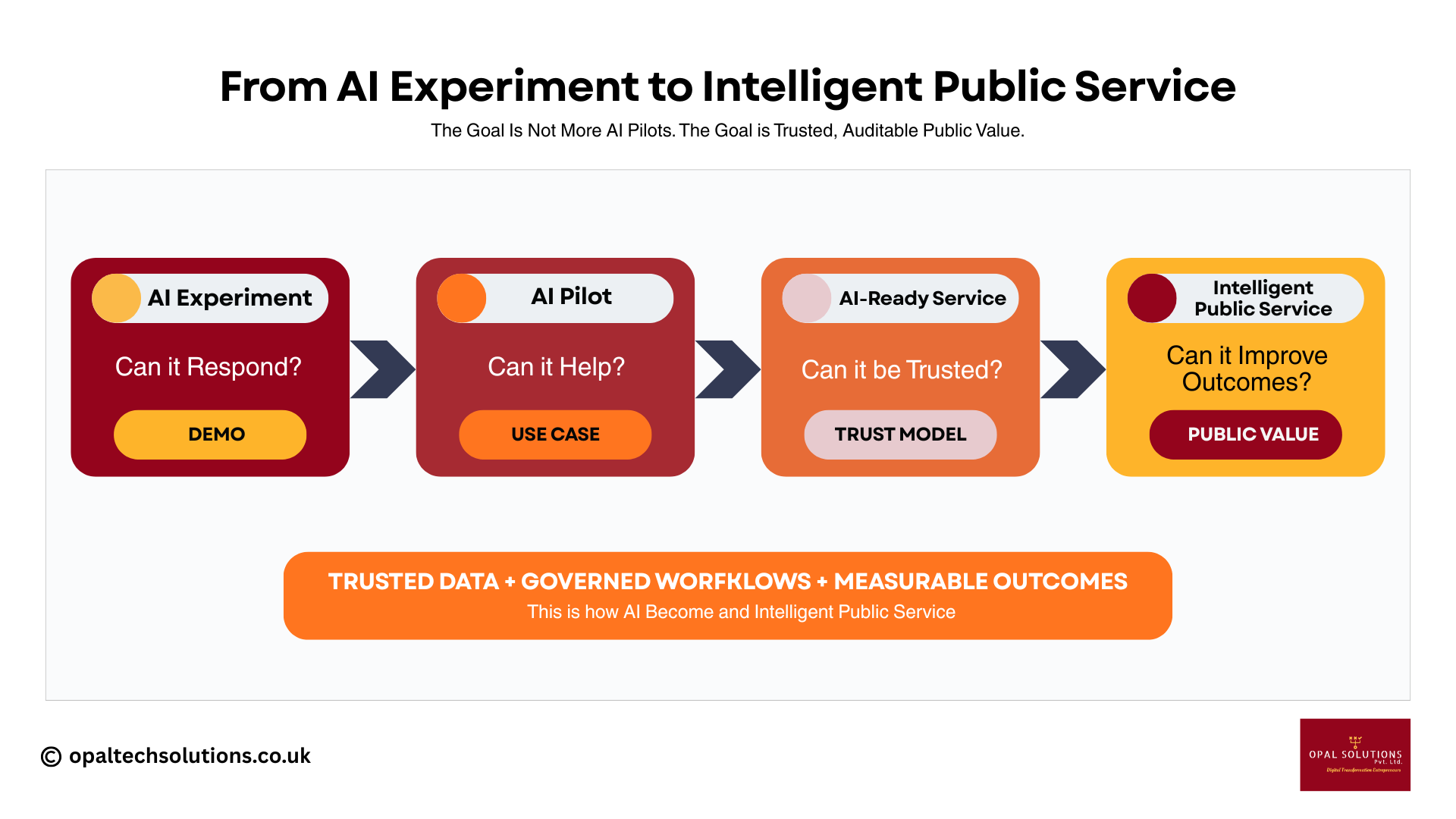
The Public-Sector Opportunity: Intelligent Services, not AI Experiments
For local authorities, the real opportunity is not to run more AI experiments.
It is to build more intelligent services.
That means services where officers see risk earlier, residents get more consistent answers, managers trust operational data, compliance evidence is easier to find, repairs patterns are easier to detect, manual checking is reduced, escalations happen sooner, decisions are auditable, and AI supports staff rather than replacing accountability.
This is where migration and modernisation become powerful.
They are not back-office IT exercises. They are the work that makes intelligent public services possible.
A council that modernises its housing data, repairs integrations, compliance records and asset information is not just preparing for a new system. It is preparing for a future where AI can help staff act with better evidence, better context and greater consistency.
That is the real prize.
Final Thoughts
AI transformation will not begin with a chatbot.
It will begin with the hard work of understanding systems, improving data, modernising platforms, connecting workflows and clarifying accountability.
That work may not attract as much attention as AI.
But it will determine whether AI succeeds.
The organisations that recognise this early will have a significant advantage.
They will not treat migration as yesterday’s IT problem. They will treat it as tomorrow’s AI foundation.
Because in the agentic era, the question is not only: Can AI understand our organisation?
The deeper question is: Have we modernised our organisation well enough for AI to understand it correctly?
Contact Us
📞 +44 (0)20 8287 7368
✉️ [email protected]
Book a 30-Minute Discovery Call with Us Now: https://opaltechsolutions.co.uk/start-your-ai-transformation

About Opal Solutions
Opal Solutions Private Limited partners with organisations across the public and private sectors to modernise legacy systems, optimise technology investments, and deliver scalable digital platforms. We specialise in Software Consultancy, Legacy Application Modernisation, Cloud Migration, and Enterprise IT & Outsourcing, helping technology leaders balance risk, cost, and long-term value.
Our teams combine strong architectural governance with practical delivery experience, enabling organisations to modernise with confidence while maintaining operational continuity.

