Legacy Modernisation: Rewrite, Refactor or Retire Systems
Legacy systems still underpin critical operations across both public and private sector organisations. In many cases, they represent decades of embedded business knowledge and operational stability. However, they are also one of the most significant sources of technical debt, cyber risk, and delivery friction in modern enterprises.
As organisations pursue digital transformation, legacy IT increasingly shifts from being a stabilising force to a strategic constraint. The real challenge for technology leaders today is no longer whether to modernise legacy systems, but how to do so safely, cost-effectively, and with long-term value in mind.
Choosing between rewriting, refactoring, or retiring a legacy application is a high-impact decision-one that directly affects cost, security posture, delivery speed, and organisational resilience.
Who this article is for:
This article is written for:
CTOs and Heads of IT
Enterprise and Solution Architects
Digital transformation leaders
IT and technology consultants
It is particularly relevant for public sector bodies, regulated industries, and growing enterprises that must balance cost control, resilience, compliance, and long-term scalability.
Why Legacy Systems Actively Block Digital Transformation
Legacy systems continue to underpin mission-critical operations across both public and private sector organisations. However, many were built for a very different era - before cloud computing, modern cyber security standards, API-driven integration, and rapid service change became essential. As a result, these systems often struggle to scale, are difficult to integrate, and require disproportionate effort to maintain or enhance.
Over time, this creates growing technical debt, increased operational risk, and rising total cost of ownership. What once provided stability now actively slows delivery, limits innovation, and exposes organisations to security and compliance challenges. In this context, legacy IT is no longer just a technical concern-it is a strategic constraint on effective digital transformation.
Understanding Your Legacy Modernisation Options
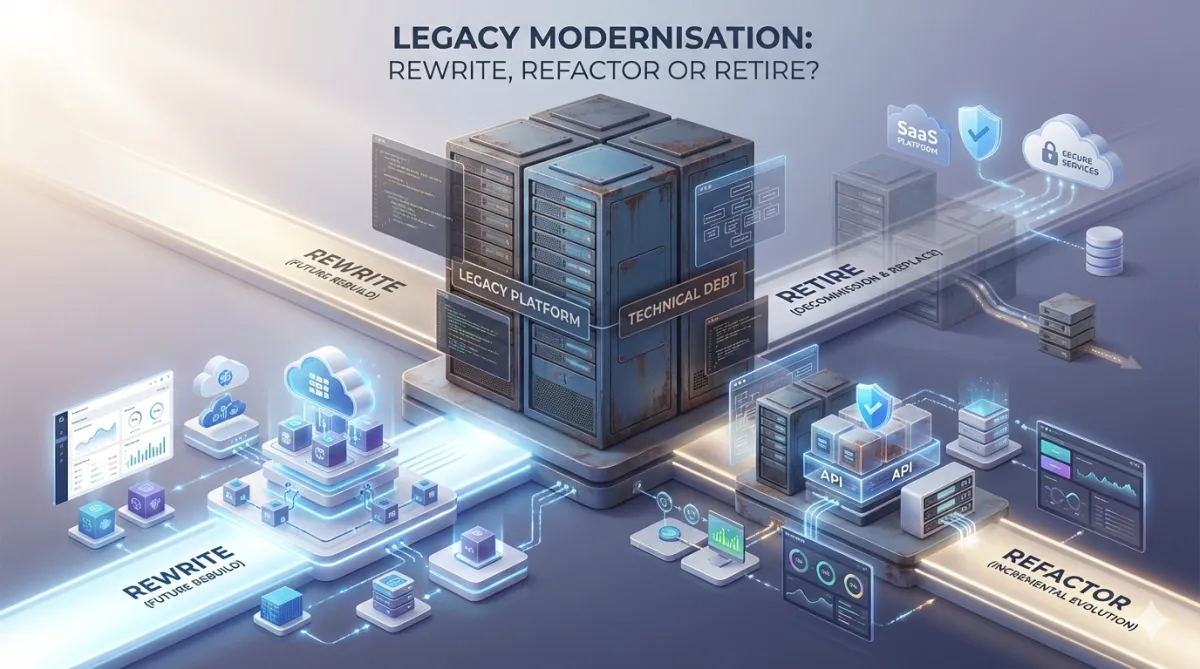
Modernising legacy systems typically falls into three strategic paths:
Rewrite – rebuild the system using modern, cloud-native architectures
Refactor – incrementally improve the existing system
Retire – decommission and replace with SaaS or strategic platforms
Each approach carries different cost, risk, and delivery implications. The right choice depends on business criticality, technical condition, and future strategic value.

The diagram illustrates a structured approach to legacy system modernisation, showing how organisations can transition from monolithic, on-premise legacy systems to a modern digital platform.
Rewrite: Rebuild from the Ground Up
Rewriting a legacy system involves re-engineering the application from first principles, replacing outdated technologies with modern, cloud-native architectures such as microservices, containerisation, and managed platform services. This approach typically includes redesigning data models, APIs, security controls, and deployment pipelines to align with current operational and regulatory requirements.
A full rewrite eliminates accumulated technical debt, removes dependency on unsupported frameworks, and enables horizontal scalability, resilience, and observability by design. It also provides an opportunity to embed modern security practices—such as zero-trust access, automated vulnerability scanning, and infrastructure as code - directly into the platform.
However, rewrites require significant upfront investment, strong architectural governance, and deep understanding of existing business rules. Delivery risk increases where legacy logic is undocumented, making phased migration, parallel run strategies, and rigorous testing essential to success.

Benefits:
• Complete removal of accumulated technical debt
• Modern security, scalability, and performance by design
• Alignment with current and future business processes
Costs and Risks:
• High upfront investment and longer delivery timelines
• Increased delivery risk if legacy business rules are poorly documented
• Requires strong governance to avoid scope creep
A rewrite is most appropriate where the underlying technology stack is obsolete, unsupported, or fundamentally misaligned with the organisation’s operating model.
Refactor: Incremental Modernisation with Reduced Risk
Refactoring focuses on improving the internal architecture, code quality, and operational characteristics of an existing system without altering its externally visible behaviour.
This typically involves decomposing tightly coupled components, introducing clear module boundaries, improving data access patterns, and establishing stable interfaces through APIs or service layers. Refactoring programmes often run alongside infrastructure modernisation, such as migrating workloads to cloud environments or introducing containerisation.

Common refactoring activities include improving automated test coverage, reducing code complexity, addressing performance bottlenecks, strengthening security controls, and implementing modern deployment practices such as CI/CD pipelines. While the core system remains intact, these changes significantly improve reliability, maintainability, and the speed at which future enhancements can be delivered.
Benefits:
Lower cost and reduced delivery risk compared to a full rewrite
Faster delivery of incremental improvements with measurable outcomes
Preservation of critical business logic and domain knowledge
Costs and Risks:
Fundamental legacy architectural constraints may remain
Technical debt is reduced but rarely eliminated entirely
Risk of prolonged dependency on ageing platforms or data models
Refactoring is best suited to systems that remain functionally valuable but require improvements in maintainability, resilience, or security.
Retire: Decommission and Simplify

Retirement involves the controlled decommissioning of a legacy system, with its capabilities either replaced by a commercial SaaS solution or absorbed into existing strategic platforms. This approach typically includes functional mapping, data extraction, migration, and long-term archival to ensure regulatory, audit, and operational requirements are met after the system is switched off.
From a technical perspective, retirement programmes focus on data integrity, interface decoupling, and dependency removal, ensuring downstream systems continue to operate correctly once the legacy application is removed. This may require temporary integration layers, data synchronisation during transition, and clearly defined cutover and rollback strategies.
Benefits:
Immediate reduction in operational, licensing, and support costs
Lower security, resilience, and compliance risk associated with unsupported systems
Simplified IT estate with fewer platforms to maintain and secure
Costs and Risks:
Complexity in data migration, cleansing, and long-term archival
Change management for users, processes, and downstream systems
Potential loss of niche, undocumented, or historically embedded functionality
Retirement is often the most cost-effective option for low-usage systems or those with widely available modern alternatives.
Making Better Decisions with Objective Frameworks

High-performing organisations avoid intuition-led decisions. Instead, they rely on repeatable frameworks such as:
Total Cost of Ownership (TCO)
TCO analysis must extend beyond license costs to include:
Infrastructure and hosting
Ongoing support and maintenance effort
Incident response and downtime
Dependency on scarce or specialist skills
Legacy systems often appear inexpensive until these hidden costs are fully understood.
Technical Debt Assessment
Technical debt manifests through fragile codebases, manual workarounds, and slow delivery cycles.
Key indicators include:
High defect rates
Difficulty implementing even minor changes
Limited automated testing
Reliance on unsupported technologies
High technical debt significantly increases long-term cost and operational risk.
Risk and Compliance
Legacy systems frequently introduce unacceptable levels of risk, including:
Security vulnerabilities
Regulatory non-compliance
Single points of failure
Where failure would have material operational or reputational impact, incremental fixes may no longer be sufficient.
Real-World Triggers That Force Modernisation
Legacy modernisation is rarely driven by long-term planning alone. In most organisations, action is triggered when legacy systems begin to actively constrain delivery, increase operational risk, or fail to meet evolving regulatory and security expectations. These pressures tend to surface through day-to-day operational challenges or strategic initiatives that cannot progress within the limitations of existing platforms.
In practice, modernisation initiatives are often triggered by:
Inability to integrate with modern APIs or cloud services
Increasing frequency of outages or performance degradation
Regulatory or cyber security requirements
Vendor end-of-support announcements
Business transformation programmes blocked by legacy constraints
These moments often force organisations to act decisively.
How Bespoke Software Modernisation Delivers Long-Term Value
Bespoke software modernisation enables organisations to modernise incrementally, reduce risk, and retain control over critical business processes. Rather than forcing operations into generic platforms, bespoke solutions are designed around real workflows and future growth.
Key advantages include:
Incremental replacement of legacy components, reducing risk
Seamless integration with existing and cloud-based systems
Security, resilience, and scalability embedded from the outset
Long-term flexibility as business needs evolve

This is where Legacy Application Modernisation, Cloud Migration, and Software Consultancy services become critical -helping organisations assess risk objectively, design phased transformation roadmaps, and deliver secure, scalable platforms aligned to long-term outcomes.
When executed correctly, bespoke modernisation does not simply replace legacy systems—it unlocks new digital capability.
Choosing the Right Path Forward
There is no universal answer to legacy modernisation. The optimal approach depends on cost, risk, and strategic value. High-performing organisations treat legacy transformation as a portfolio decision, balancing short-term pragmatism with long-term resilience.
Whether rewriting, refactoring, or retiring, the most important step is acting deliberately - before legacy systems become a critical barrier to security, delivery, or growth.
Final Words: How Opal Solutions Supports Legacy Modernisation
At Opal Solutions Private Limited, we help organisations navigate these decisions with confidence. Our approach combines deep technical expertise with a strong understanding of business processes, enabling technology leaders to make informed, evidence-based modernisation choices.
Through our Legacy Application Modernisation, Cloud Migration, and Software Consultancy services, we support organisations in assessing technical debt, managing risk, and delivering secure, scalable platforms aligned to long-term strategic outcomes. We act as a trusted decision-support partner—helping you modernise incrementally where appropriate, transform decisively where necessary, and avoid unnecessary disruption.
If your organisation is facing legacy constraints that are limiting delivery, increasing risk, or slowing transformation, we would be happy to explore how a structured modernisation approach can help.
Contact Us
📞 +44 (0)20 8287 7368
✉️ [email protected]
Book a 30-Minute Discovery Call with Us Now: https://opaltechsolutions.co.uk/book-a-call
About Opal Solutions
Opal Solutions Private Limited partners with organisations across the public and private sectors to modernise legacy systems, optimise technology investments, and deliver scalable digital platforms. We specialise in Software Consultancy, Legacy Application Modernisation, Cloud Migration, and Enterprise IT & Outsourcing, helping technology leaders balance risk, cost, and long-term value.
Our teams combine strong architectural governance with practical delivery experience, enabling organisations to modernise with confidence while maintaining operational continuity.

