Agentic AI: Moving from Intelligent Tools to Autonomous Digital Systems
Artificial Intelligence has evolved rapidly over the past decade. Organisations have moved from rule-based automation, to machine learning models, and more recently to generative AI systems capable of natural language interaction and reasoning.
We are now entering a new phase.
A phase in which AI systems do not simply respond to inputs, but plan, act, and adapt in pursuit of defined goals.
This shift is known as Agentic AI, and it represents a material change in how organisations design, deploy, and govern digital systems across enterprise IT, cloud operations, and public sector service delivery.
At Opal Solutions, we view agentic AI not as a distant concept, but as a practical architectural pattern that is already influencing how complex systems are built and operated.
This article explains:
What agentic AI actually is, beyond the hype
How it differs from traditional AI and automation
The architectural building blocks of agentic systems
Practical examples using Amazon Web Services
Why governance and accountability matter as much as capability
From Reactive AI to Agentic Systems

Most AI systems currently deployed in production environments are reactive. A human or system provides an input, such as:
A prompt
A document
A data stream
An alert
The AI system produces an output:
A prediction
A classification
A summary
A recommendation
While these systems can be highly effective, they stop at insight. Humans remain responsible for deciding what happens next.
Agentic AI introduces a different operating model. Agentic systems are designed to:
Interpret objectives rather than single inputs
Determine which actions are required
Execute those actions using approved tools
Observe outcomes
Adapt behaviour based on feedback
In effect, agentic AI operates in continuous decision loops, rather than isolated interactions.
What Is Agentic AI?
At a practical level, agentic AI refers to AI systems that can autonomously plan, act, and adapt in pursuit of a goal, within defined boundaries.

Key characteristics include:
Goal orientation – the system works towards an explicit objective
Autonomy – it determines how to progress towards that goal
Tool usage – it interacts with external systems and services
State awareness – it tracks progress over time
Feedback loops – it evaluates outcomes and adjusts behaviour
Importantly, well-designed agentic systems are not uncontrolled. Autonomy is constrained, observable, and governed through architecture, policy, and human oversight.
Agentic AI Versus Traditional Automation

Understanding the value of agentic AI requires comparison with earlier approaches.
Traditional automation is:
Rule-based
Workflow-driven
Static and predictable
Dependent on predefined decision trees
Agentic AI is:
Goal-based
Capable of dynamic planning
Context-aware
Able to adapt based on outcomes
Traditional automation excels in stable, repeatable processes. Agentic AI excels in environments where:
Inputs are unstructured
Conditions change
Trade-offs must be evaluated
Decisions require judgement rather than rules
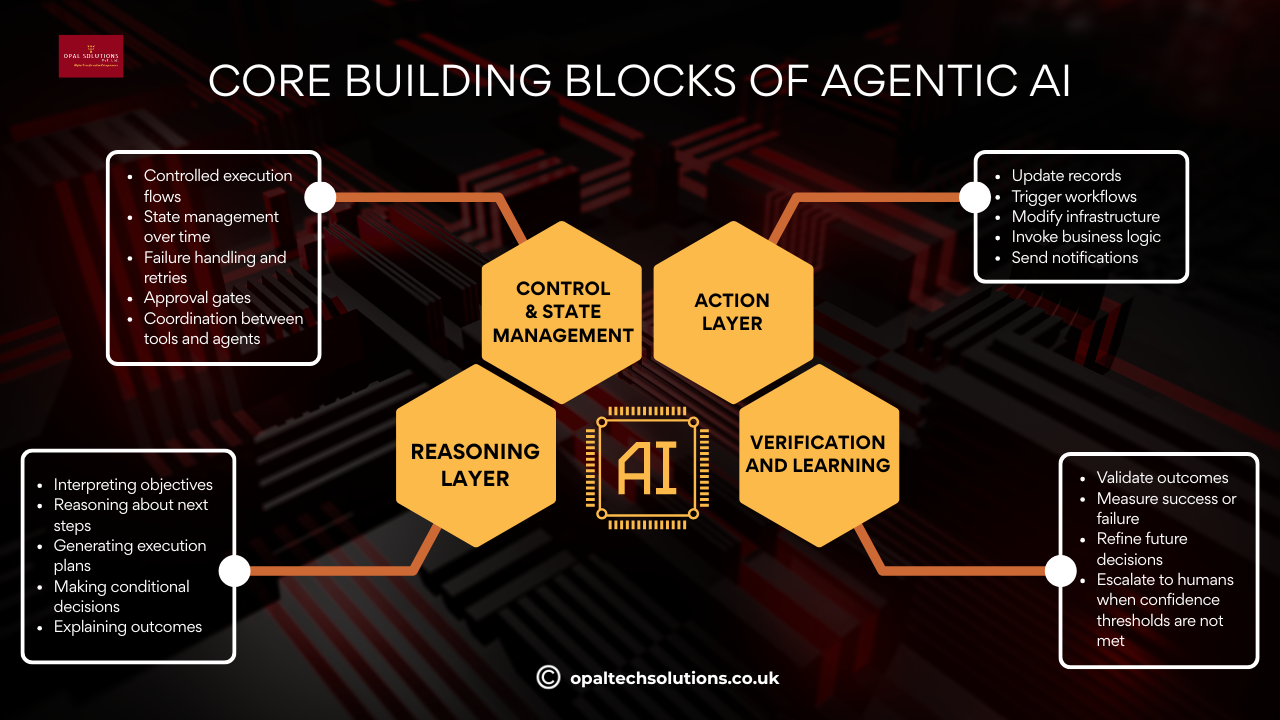
The Core Building Blocks of Agentic AI
Agentic AI is not a single product or platform. It is an architectural composition built from four essential components.
Foundation Models (Reasoning Layer)
Foundation models provide the reasoning capability of an agent.
Within AWS environments, this is commonly delivered through services such as Amazon Bedrock, which hosts large language and multimodal models including:
Anthropic Claude
Amazon Titan
Meta Llama
These models are responsible for:
Interpreting objectives
Reasoning about next steps
Generating execution plans
Making conditional decisions
Explaining outcomes
They act as the cognitive core of the system.
Orchestration (Control and State Management)
Autonomy without structure introduces risk. Orchestration services such as AWS Step Functions and Amazon EventBridge provide:
Controlled execution flows
State management over time
Failure handling and retries
Approval gates
Coordination between tools and agents
Orchestration ensures that agentic behaviour remains predictable, auditable, and safe.
Tools (Action Layer)
Insight alone does not create value.
Agentic systems are connected to tools that allow them to interact with real systems, including:
AWS Lambda
Amazon S3
Amazon DynamoDB
Amazon EC2
Through these integrations, agents can:
Update records
Trigger workflows
Modify infrastructure
Invoke business logic
Send notifications
This is where AI moves from recommendation to execution.
Feedback Loops (Verification and Learning)
True autonomy requires verification. Services such as Amazon CloudWatch, AWS CloudTrail, and Amazon QuickSight enable agents to:
Validate outcomes
Measure success or failure
Refine future decisions
Escalate to humans when confidence thresholds are not met
Feedback loops are what distinguish agency from automation.

Real-World Agentic AI Use Cases on AWS
Autonomous Incident Response (AIOps)
Agents monitor metrics and logs, diagnose likely root causes, execute approved remediation actions, and verify recovery, escalating only when required.
FinOps and Cost Optimisation
Agents continuously analyse spend, identify waste, implement rightsizing actions, and reassess impact on a rolling basis.
Intelligent Document and Case Processing
In public sector and regulated environments, agents classify documents, extract data, apply policy rules, and determine whether cases can be processed automatically or require escalation.
Software Engineering and Platform Agents
Engineering agents review tickets, analyse codebases, run tests, open pull requests, and monitor CI/CD outcomes, acting as AI teammates rather than replacements.
Governance: The Defining Factor for Success

Autonomy without governance introduces unacceptable risk. Responsible agentic AI design must include:
Clear authority boundaries
Human-in-the-loop controls
Approval thresholds
Comprehensive audit trails
Explainability
Security-by-design principle
AWS provides strong foundational controls, but architecture choices determine whether those controls are effective.
Agentic AI should enhance human decision-making, not bypass it.
Why Agentic AI Matters Now
Several forces are converging:
Increasing system complexity
Skills shortages
Rising operational costs
Demand for faster service delivery
Rapid advances in foundation models
Agentic AI offers organisations a way to:
Scale decision-making capacity
Reduce coordination overhead
Improve responsiveness
Maintain accountability
This is particularly relevant for enterprise IT, regulated industries, and public sector organisations operating across complex, interconnected systems.
Final Thoughts
Agentic AI represents the transition from AI as a tool to AI as a system.
Organisations that understand this shift early, and implement it deliberately, will be better positioned to deliver resilient, scalable, and adaptive digital services.
The question is no longer whether agentic AI will be adopted.
It is how responsibly and intentionally it will be designed.
At Opal Solutions, we support organisations in moving beyond experimentation towards production-ready, governed AI systems that deliver measurable operational value.
Our approach to agentic AI combines software consultancy, cloud architecture, and modern delivery practices to ensure autonomy is implemented responsibly, securely, and in alignment with organisational objectives.
If your organisation is exploring agentic AI and wants to understand how it can be applied practically, securely, and responsibly within your existing technology landscape, we would be pleased to discuss your objectives.
Contact Us
📞 +44 (0)20 8287 7368
✉️ [email protected]
Book a 30-Minute Discovery Call with Us Now: https://opaltechsolutions.co.uk/book-a-call

About Opal Solutions
Opal Solutions Private Limited partners with organisations across the public and private sectors to modernise legacy systems, optimise technology investments, and deliver scalable digital platforms. We specialise in Software Consultancy, Legacy Application Modernisation, Cloud Migration, and Enterprise IT & Outsourcing, helping technology leaders balance risk, cost, and long-term value.
Our teams combine strong architectural governance with practical delivery experience, enabling organisations to modernise with confidence while maintaining operational continuity.

